Error loading page.
Try refreshing the page. If that doesn't work, there may be a network issue, and you can use our self test page to see what's preventing the page from loading.
Learn more about possible network issues or contact support for more help.

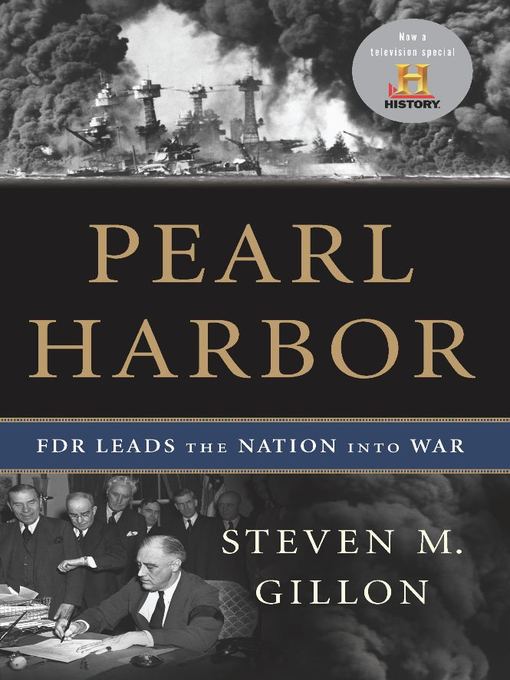
Pearl Harbor

FDR Leads the Nation Into War

ebook
1 of 1 copy available
Franklin D. Roosevelt famously called December 7, 1941, "a date which will live in infamy." History would prove him correct; the events of that day — when the Japanese bombed Pearl Harbor — ended the Great Depression, changed the course of FDR's presidency, and swept America into World War II. In Pearl Harbor, acclaimed historian Steven M. Gillon provides a vivid, minute-by-minute account of Roosevelt's skillful leadership in the wake of the most devastating military assault in American history. FDR proved both decisive and deceptive, inspiring the nation while keeping the real facts of the attack a secret from congressional leaders and the public.
Pearl Harbor explores the anxious and emotional events surrounding the attack on Pearl Harbor, showing how the president and the American public responded in the pivotal twenty-four hours that followed, a period in which America burst from precarious peace into total war.
  • Creators

  • Publisher

  • Release date

  • Formats

  • Accessibility

  • Languages

  • Reviews

    • Kirkus

      September 15, 2011

      Japanese planes appeared over Oahu at 1:25 p.m., Washington time, on Dec. 7, 1941. This superior addition to the snapshot genre of historical writing describes the following 24 hours, ending when FDR delivered his famous "day of infamy" message to Congress.

      The History Channel resident historian Gillon (History/Univ. of Oklahoma; The Kennedy Assassination--24 Hours After: Lyndon B. Johnson's Pivotal First Day as President, 2009, etc.) reminds readers that everyone expected war. Having broken Japan's diplomatic code, American officials knew that morning that Japan's embassy had been ordered to destroy its code machines. Everyone assumed the Japanese fleet (known to have sailed) would move south to obtain desperately needed oil and natural resources from weakly defended British and Dutch Southeast Asia colonies. A San Francisco Naval station picked up news of the raid and relayed it to Washington, where a flabbergasted FDR received it at 1:47. Gillon paints a vivid picture of the scramble that followed as he summoned his cabinet, aides and Congressional leaders from their Sunday rest. Meetings throughout the day served mostly to agonize over how American forces were caught napping and exchange wild rumors (swastikas on the wings of attacking planes, Japanese troops landing on Hawaii)--as well as to vow revenge. Little useful activity and no important decisions resulted, and Gillon wisely cuts away from the confusion to deliver background information and generous biographies of FDR, Eleanor and a dozen leading figures.

      An excellent introduction to Roosevelt and his times with heavy emphasis on events surrounding Pearl Harbor.

      (COPYRIGHT (2011) KIRKUS REVIEWS/NIELSEN BUSINESS MEDIA, INC. ALL RIGHTS RESERVED.)

    • Booklist

      November 1, 2011
      Accounts of the events leading to the Japanese attack, the attack itself, and the immediate aftermath are, of course, plentiful. This work is unusual, even unique, in that it concentrates on the actions of President Roosevelt and his closest associates as the attack unfolded and they began to come to grips with the enormous task facing the nation. Gillon, professor of history at the University of Oklahoma, does not sugarcoat Roosevelt's personal qualities. Beneath his gregarious veneer, Roosevelt was often distant, deceptive, and prepared to discard associates when they no longer were useful. But in this gigantic crisis, Gillon shows Roosevelt as decisive and an intuitive leader. Gillon effectively sets the stage by describing the administration's view of the international situation. Germany was regarded as the main threat, but as relations with Japan deteriorated, an attack was expected somewhere in the Pacific. But Pearl Harbor didn't seem a likely target. Gillon conveys the initial sense of shock and confusion as Roosevelt and his advisors get minute-by-minute updates. As the enormity of the disaster becomes clear, Roosevelt's stature seems to rapidly grow. This is an engrossing and highly informative chronicle of crisis management at a decisive moment in history.(Reprinted with permission of Booklist, copyright 2011, American Library Association.)

Formats

  • Kindle Book
  • OverDrive Read
  • EPUB ebook

subjects

Languages

  • English

Loading